
Why Cloud Migrations Exceed Budgets Before Delivering Value
Cloud migration is almost always approved as a cost-saving initiative. Yet many organizations discover the exact opposite in the first few months: cloud subscriptions, unplanned licensing shifts, data egress fees, security tooling, parallel-run overhead, and consultant hours arrive long before business value materializes.

The Problem: Budgets Are Approved, Then Reality Changes
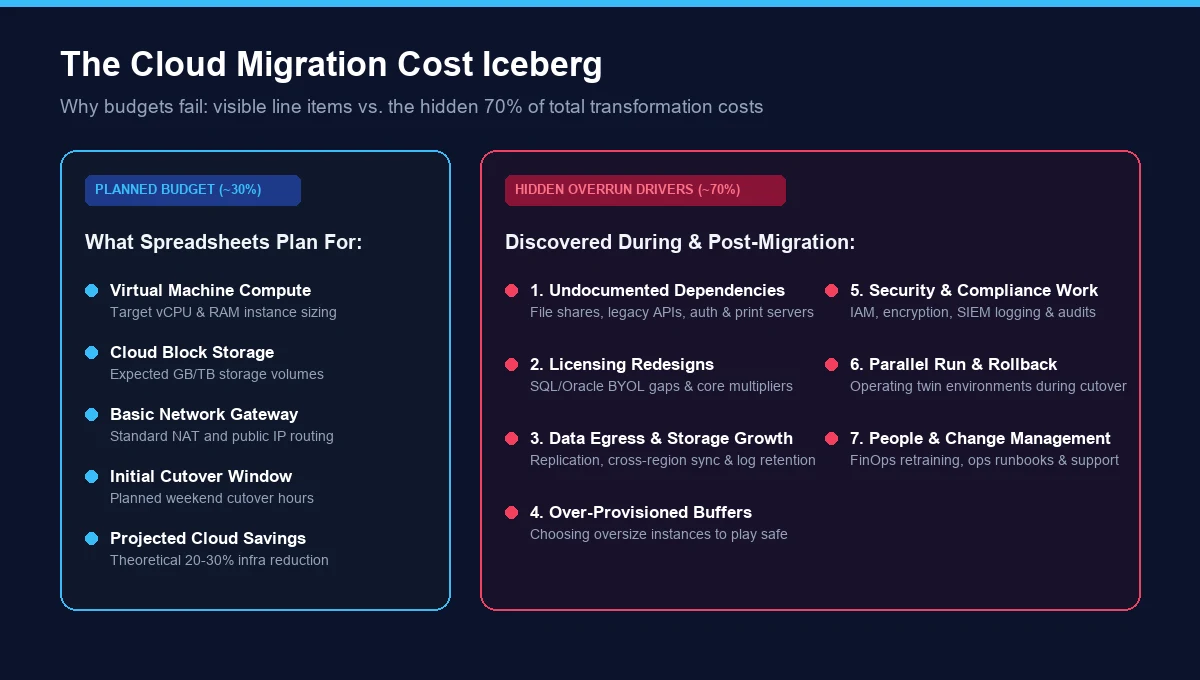
A typical cloud transformation begins with an executive spreadsheet: current physical servers, estimated target cloud instance sizes, expected cloud storage, and a projected six-month cutover timeline. That estimate invariably looks reasonable on paper, promising a 20% to 30% reduction in capital infrastructure expenditures.
Promised 20% to 30% reduction in capital expenditures based on static hardware sizing.
Surging cloud subscriptions, unbudgeted licensing shifts, egress fees, and emergency re-work.
However, once discovery and execution begin, engineering teams regularly uncover realities that spreadsheets never accounted for:
Undocumented System Dependencies
Applications tied to unmapped legacy APIs, local file shares, specialized printer queues, or on-premise Active Directory forests.
Legacy Database Sprawl
On-premise databases with massive, undocumented data volumes, complex stored procedures, and unpredictable query locks.
Licensing Portability Traps
Enterprise vendor licenses (such as Microsoft SQL Server or Oracle) that do not transfer cleanly to multi-tenant cloud instances without substantial pricing multipliers.
Unpredictable Seasonal Workloads
Systems that run quietly at 15% CPU for months, but demand 10x burst capacity during month-end closes or peak seasonal cycles.
Unplanned Security & Compliance Tooling
Centralized log aggregation, SIEM ingestion fees, data encryption key management, and zero-trust identity frameworks that were never included in the original scope.
Staff Skill Gaps
Internal IT teams needing extensive training, revised operating procedures, and round-the-clock support during live cutovers.
AWS Well-Architected Migration Guidance
AWS specifically recommends collecting a complete, fine-grained asset inventory, mapping all application interdependencies, and gathering actual utilization telemetry—not merely allocated capacity—before designing the target environment. Furthermore, AWS advises sampling telemetry over a minimum two-week window to accurately benchmark minimum, average, and peak enterprise demand.
Without that level of readiness, the cloud migration plan degenerates into a moving target. Every uncovered unknown triggers an urgent scope change request, an emergency software purchase, or an expensive timeline delay.
Why Conventional Migration Planning Fails
Many migration budgets fail because executive teams treat cloud migration as a straightforward infrastructure move (lift-and-shift). In reality, moving to the public cloud is a profound operating-model change. When organizations attempt to run cloud environments using static data-center mentalities, cost overruns are virtually guaranteed.
“We will migrate servers exactly as they are.”
Applications require architectural redesign, containerization, dependency rewrites, or database refactoring to run reliably in the cloud.
“Cloud will automatically reduce infrastructure spend.”
Without rigorous rightsizing, idle test resources, oversized buffers, and unmonitored consumption patterns cause monthly bills to surge higher than on-premise costs.
“Software licensing remains the same.”
Windows Server, SQL Server, and legacy enterprise database vendors enforce cloud-specific core licensing rules that frequently demand dedicated cloud hosts or costlier tiers.
“The existing IT team can execute migration alongside daily duties.”
Migration demands dedicated engineering focus, rigorous rollback testing, multi-tier security reviews, and structured organizational change management.
“We will optimize costs after we go live.”
Architectural decisions locked in during initial provisioning define the monthly baseline. Optimizing post-launch is 5x to 10x more expensive than designing for cost upfront.
The FinOps Foundation Principle
Cost must be treated as an active design parameter, not a retrospective accounting exercise. Governance, resource tagging taxonomy, and real-time anomaly detection must be embedded into the migration lifecycle before a single workload is provisioned.
Where Cost Overruns Hurt the Business Most
Cloud migration budget overruns do not stay confined within the IT department. Their impact cascades across the entire C-suite and operational frontline:
CFO & Finance Leadership
Financial forecasting becomes erratic as variable OpEx charges arrive unpredictably. Capital allocation models break, planned cost reductions are deferred, and trust in technology business cases erodes.
CTO & CIO Leadership
Senior engineering leaders are forced into defensive firefighting mode—triaging billing anomalies and justifying scope creep instead of delivering promised digital innovation and modernization roadmaps.
COO & Operations Heads
Production lines, warehouse dispatch systems, and customer fulfillment portals encounter unplanned latency hiccups or cutover delays, jeopardizing delivery commitments and customer trust.
Business Unit Owners
The business case that justified the program recedes into the distance. Product launches are delayed as shared IT resources remain tied up resolving prolonged cutover and integration issues.
Multi-Year ROI Perspective
Cloud migration ROI must never be evaluated solely on day-one hosting prices. It must be measured across a 3- to 5-year horizon that integrates migration execution costs, ongoing run rates, developer productivity, security posture improvement, and business capability gained.
A Practical 5-Stage Framework to Control Migration Costs
To avoid the pitfalls of ungoverned spending, leadership teams should enforce this structured five-stage lifecycle before signing off on migration budgets.
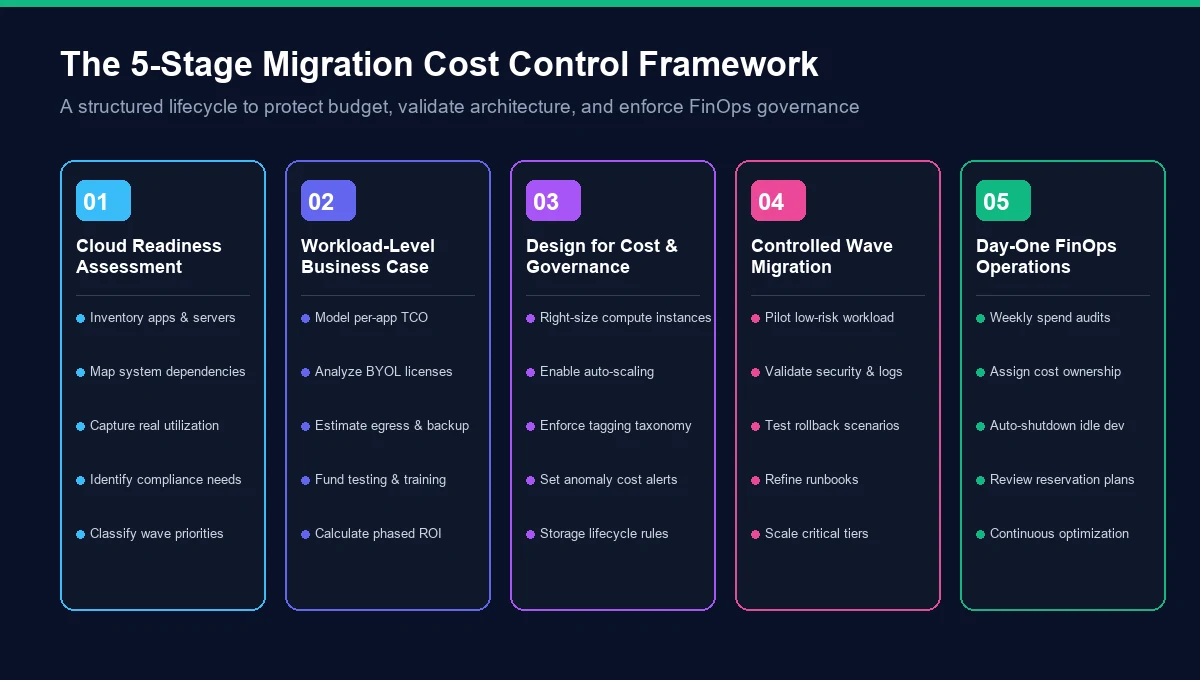
Run a Cloud Readiness Assessment
Before drawing architectures or approving cloud subscriptions, evaluate your current estate thoroughly to understand dependencies and true baseline consumption.
12-Point Cloud Migration Cost Optimization Checklist
Before approving capital allocation or signing multi-year cloud commitments, verify that your technology and finance teams have completed these twelve diligence gates:
How Vivify Soft Tech Helps Control Migration Costs
Vivify Soft Tech partners with forward-looking enterprises to make cloud transformation practical, measurable, and financially predictable. Rather than relying on generic lift-and-shift estimations, we build programs founded on exhaustive discovery, rigorous architecture design, active security compliance, and embedded FinOps governance.
Cloud Readiness Assessment & Planning
Exhaustive inventory discovery, automated dependency mapping, and workload-by-workload TCO modeling to formulate a phased, risk-mitigated migration roadmap.
DevOps & Cloud Infrastructure Operations
Automated Infrastructure as Code (IaC), continuous CI/CD pipelines, automated right-sizing, and 24/7 telemetry monitoring to safeguard performance while eliminating wasted spend.
Custom Software & SaaS Modernization
Refactoring legacy monolithic applications into modular, cloud-native microservices and containerized architectures that optimize compute consumption.
ERP & Hyperautomation Integration
Connecting cloud applications seamlessly with core enterprise systems, eliminating data silos and manual handoffs across sales, finance, operations, and procurement.
Industrial IoT & Smart Factory Systems
Enabling reliable, secure telemetry pipelines between shop-floor controllers, edge gateways, on-premise PLCs, and cloud analytics platforms for discrete manufacturers.
Cloud Security, Governance & FinOps
Zero-trust access architectures, unified logging, regulatory compliance validation, and continuous FinOps billing audits that keep your cloud investment fully controlled.
For growing enterprises and mid-market leaders in Chennai, Tamil Nadu, and across India, Vivify Soft Tech transforms cloud migration from an unpredictable budget gamble into an engineered, financially disciplined competitive advantage.
Frequently Asked Questions (FAQs)
Cloud migration projects exceed budgets because teams underestimate discovery, dependencies, licensing, data transfer, security, testing, parallel running, training, and ongoing cloud consumption. The original estimate often covers infrastructure compute and storage prices but completely misses the full cost of architectural, cultural, and operational change.
Need a Cloud TCO Assessment?
Connect with Vivify's senior cloud architects to benchmark your infrastructure costs and engineer a zero-overrun migration roadmap.
Talk to Cloud Architects