
Why Your SaaS MVP
Is Slow to Launch,
and It Is Not the Code
SaaS MVP launch delays are usually caused by unclear scope, weak validation, and slow decisions, not engineering. Learn how to fix your MVP development timeline.
Why Your SaaS MVP Is Slow to Launch, and It Is Not the Code
Your SaaS MVP is late. The engineering team is working, tickets are moving, and demos look promising but launch day keeps slipping.
The instinct is to blame the code: “The developers are slow,” “We need more engineers,” or “We should have used a different tech stack.”
In reality, code is rarely the first bottleneck in SaaS MVP development. The delay usually begins much earlier: the team is trying to build too much, validate too little, and make product decisions while development is already underway.
An MVP is not a smaller version of the final product. It is the smallest version that lets you test whether users receive meaningful value before you invest in a full-scale solution.
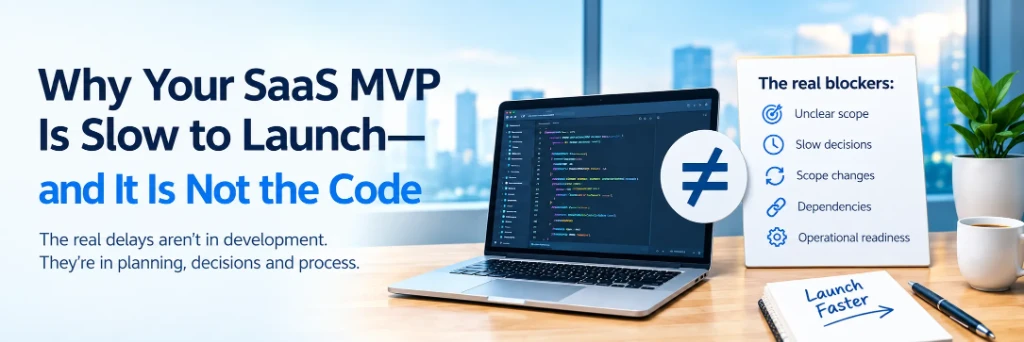
Why Your MVP Is Really Slow
Teams instinctually blame the codebase, but the earliest bottlenecks start before development begins:
- Unclear scope & unvalidated buyer assumptions
- Trying to please every stakeholder in version one
- Late-stage technical & compliance surprises
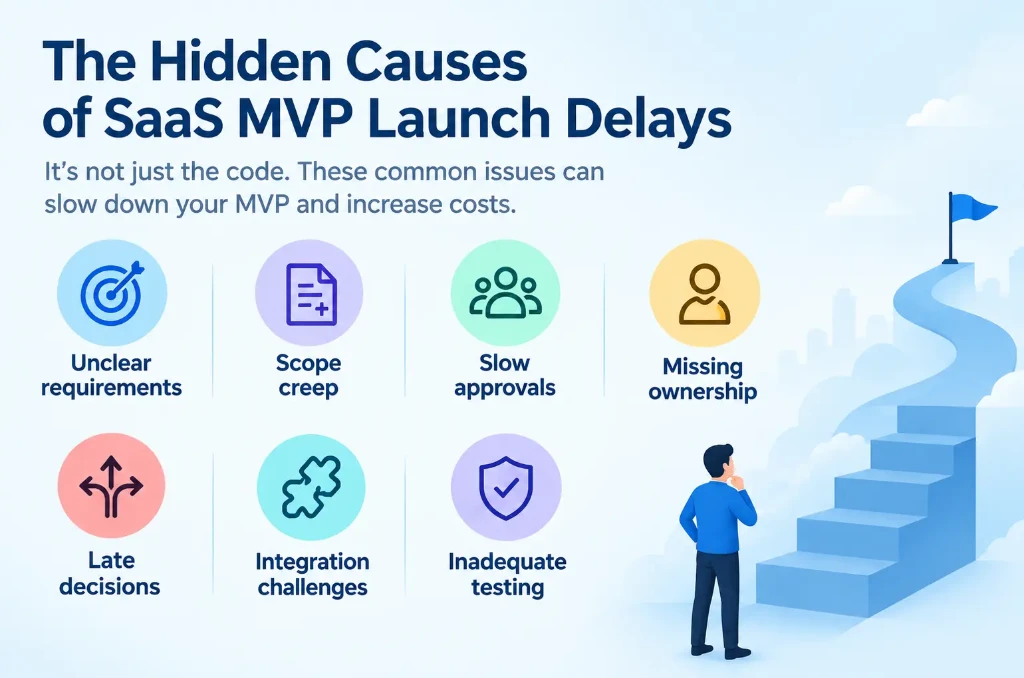
The real cost of a delayed MVP
A delayed SaaS MVP is not merely a missed deadline. It creates a chain of business consequences:
Burned Runway
Every additional month of development consumes cash before the product generates learning, revenue, or investor evidence.
Lost Market Timing
Competitors can reach the same buyer first, even with a less sophisticated product.
Stakeholder Fatigue
Founders, investors, and internal teams lose confidence when launch dates repeatedly move.
Scope Inflation
Late-stage “small additions” often require rework across design, backend, integrations, testing, and deployment.
Weak Launch Readiness
Even when the software is complete, onboarding, support, billing, security review, and customer communication may not be ready.
CB Insights’ analysis of failed venture-backed startups found that poor product-market fit was cited by 43% of companies, while running out of capital affected 70%, though capital exhaustion was often the symptom rather than the root cause. In other words, delay is expensive not only because it consumes time, but because it postpones the evidence that tells you whether the product should be built at all.
Why conventional MVP approaches fail
Many teams treat an MVP as “build the core product quickly.” That sounds reasonable, but it hides several failure modes.
| Common approach | Why it delays launch | Better MVP practice |
|---|---|---|
| Build every feature stakeholders request | The backlog becomes a compromise document, not a product strategy | Prioritize one user, one problem, and one measurable outcome |
| Start coding after a high-level idea | Requirements emerge during development, causing rework | Define user journeys, acceptance criteria, and release boundaries first |
| Treat validation as something to do after launch | The team builds before testing demand or workflow fit | Validate the problem, buyer, and workflow before committing to build |
| Measure progress by features completed | Feature count rises while launch readiness does not | Measure decision readiness, test coverage, and ability to onboard a real user |
| Add “quick” integrations late | Authentication, billing, data migration, and third-party APIs create hidden dependencies | Identify integration and compliance constraints during scoping |
A practical 5-part MVP scoping framework
Use this five-part framework before writing production code.
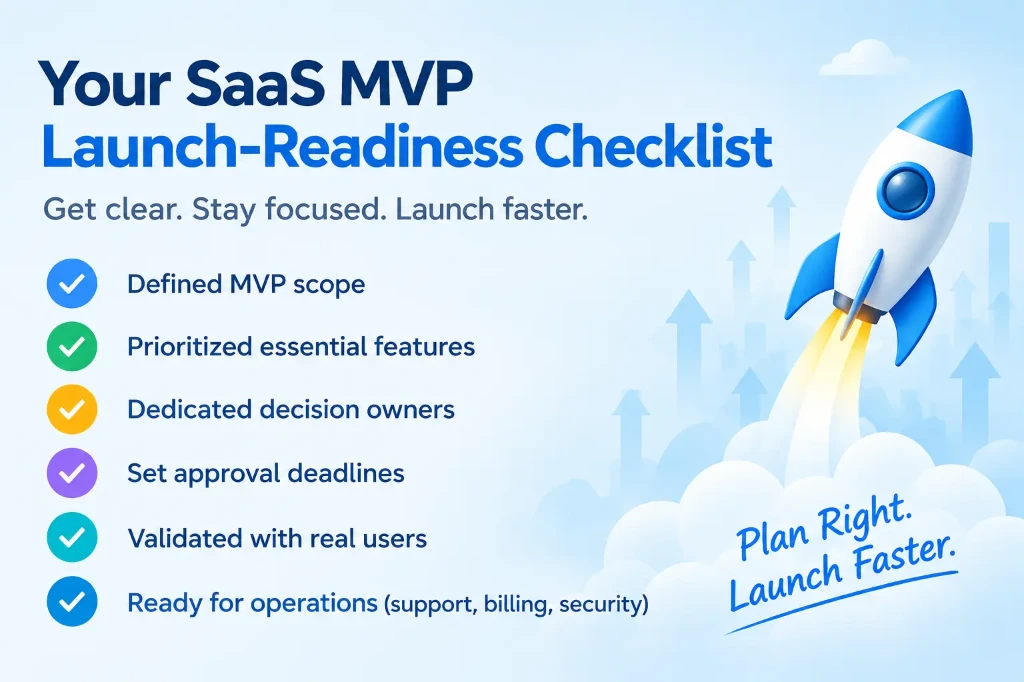
Your MVP Launch-Readiness Checklist
Follow these essential milestones before committing to engineering sprints:
- Clearly defined, razor-sharp MVP scope
- Prioritize essential, high-impact features
- Assign dedicated decision owners & deadlines
- Validate with real users & design partners
- Operational readiness (billing, auth, security)
Define the riskiest assumption
Ask: “What must be true for this product to work?” Examples include:
- Operations managers will trust automated recommendations.
- Sales teams will upload customer data without IT support.
- Buyers will pay for a workflow they currently manage in spreadsheets.
- A field technician can complete the core task on a mobile device.
Rule: Build the smallest thing that tests that specific assumption.
Choose one beachhead workflow
Select one user type and one end-to-end workflow. Resist the temptation to support every variation. A proven scope formula template is:
“A [user role] can [complete action] to achieve [outcome], using [essential data/integration], without [explicitly excluded capability].”
Separate must-have from eventually
Create three distinct lists before development starts:
- Must-have: The product cannot test the core hypothesis without it.
- Fast-follow: Important, but not required for initial learning.
- Explicitly excluded: Not part of this MVP, even if technically feasible.
This list should be reviewed and locked by product, engineering, sales, and leadership before sprint 1.
Define launch readiness, not feature completeness
A launch-ready MVP includes:
- One primary user journey working end to end
- Basic authentication and role-based access control
- Core data model and essential integrations
- Error handling for expected system failures
- Onboarding for the first customer user group
- Basic telemetry to measure activation and retention
- A clear support, feedback, and rollback response plan
It explicitly excludes advanced reporting, custom permissions, complex workflow builders, white-labeling, and wide-ranging integrations.
Set a time-boxed learning goal
Instead of asking, “Can we build these 25 features in 12 weeks?” ask:
Outcome-Driven Goal: “Can we put a real user through the core workflow within 10 weeks and learn whether they will use it again?”
What a realistic MVP timeline looks like
Timelines vary by complexity, team experience, compliance needs, and integrations. But a disciplined MVP often follows this sequence:
Discovery
Focus: Customer problem, buyer, workflow, constraints.
Typical output: Problem statement, target user, success metrics.
Scoping
Focus: MVP boundary, risks, architecture direction.
Typical output: Prioritized scope, out-of-scope list, delivery plan.
Design
Focus: Core journey and usability.
Typical output: Clickable prototype, acceptance criteria.
Build
Focus: Core workflow, essential infrastructure.
Typical output: Working software in a testable environment.
Pilot
Focus: Real-user validation.
Typical output: Feedback, usage data, prioritized fixes.
Launch
Focus: Controlled release.
Typical output: Onboarding, support, analytics, release checklist.
The goal is not to predict every detail. It is to make the next decision easier with empirical evidence.
When code really is the problem
Code can become the bottleneck, but usually after a product issue has already created it. Common technical causes include:
- Rebuilding the architecture after scope changes
- Poor test coverage that makes every change risky
- Manual deployment and inconsistent development/staging environments
- Unclear API contracts between frontend and backend
- Underestimated integration complexity and third-party rate limits
- Lack of observability, making defects hard to diagnose
- Security or compliance work discovered late
These are solvable, but they should be surfaced during scoping, not during launch week.
How Vivify Soft Tech approaches MVP delays
Vivify Soft Tech works with startups and enterprises to turn broad product ideas into implementable SaaS MVP scopes. As an AI-first enterprise technology company based in Chennai, Vivify provides custom software, SaaS and mobile product development, cloud and DevOps services, workflow automation, AI business solutions, and digital transformation support.
For an MVP that is stuck, the first engagement is not “write more code.” It is an MVP scoping session to clarify:
- The primary user and core workflow
- The riskiest product assumption
- Must-have versus fast-follow scope
- Technical, security, and integration constraints
- Launch-readiness criteria and realistic MVP timelines
Key takeaways
1. Code speed is rarely the root issue: Launch delays usually stem from broad scope, changing requirements, and slow decision-making.
2. Narrow your initial boundary: Build for one primary user, one beachhead workflow, and one measurable outcome.
3. Validate before building: Test customer demand, willingness to pay, and workflow fit with prototypes before committing engineering capacity.
4. Focus on launch readiness: An MVP is complete when a real user can complete the core workflow and the team can support and measure it.
Frequently asked questions
Related Resources & Authoritative References
Explore related engineering and strategy guides on the Vivify Insights Hub, or consult the foundational research papers from CB Insights, Nielsen Norman Group, The Standish Group CHAOS Report, and arXiv’s Systematic Mapping Study on MVP Definitions.