
Why Your Business Data
Does Not Help You Decide Faster
Most companies do not have a shortage of data—they have a problem connecting it. Sales sits in CRM, inventory in ERP, machine telemetry on the shop floor, and quality logs in spreadsheets. Discover why disconnected systems paralyze operational speed, the true cost of data silos, and how business process automation builds real-time decision clarity.

1. The Data Paradox: Too Much Data, Too Little Clarity
Most modern enterprises do not suffer from an absence of data. They drown in it. Every department has invested in specialized digital tools over the past decade:
Customer demand and delivery commitments remain invisible to factory planners.
Safety stock and inventory batches delayed by end-of-shift reconciliation runs.
High-frequency line run-rates and micro-stoppages never reach executive visibility.
Dimensional scrap defects logged on tablets after bad parts leave the cell.
Preceding thermal and vibration warnings buried under nuisance alarm floods.
Fragile VLOOKUPs and manual clipboard exports stitched together by analysts.
The Universal Executive Dilemma
When the CEO or Managing Director asks, “Can we commit to delivering this 50,000-unit custom order by next Friday and still protect our gross margins?” the leadership team needs three full days of emergency meetings, manual spreadsheet compilation, and cross-department phone calls just to formulate an answer.
The problem is fundamentally not a lack of data. The problem is that data is kept in architecturally isolated silos. Because no single system holds the unified context, nobody can see the complete operational picture in time to influence the outcome.
Source: IDC Enterprise Intelligence & Decision Velocity Benchmark Studies. When decisions take days, the data being acted upon no longer reflects reality.
2. What “Making Decisions Without Full Information” Looks Like
In manufacturing plants, logistics hubs, and mid-market enterprises, disconnected data manifests in predictable, recurring operational frictions that leadership often mistakes for human incompetence:
Production reports fail to reconcile with ERP & finance ledgers
The shop-floor system reports 12,000 parts produced, but warehouse receipts show only 11,200, leaving planners guessing whether the missing balance represents unrecorded scrap or transit lag.
Machine stoppages are known on the floor, but planning learns hours late
A stamping press or packaging cell trips at 9:15 AM. The master production schedule continues assuming full throughput until the shift supervisor files a manual paper log at 5:00 PM.
Purchasing places raw material orders blind to live machine capacity
Purchase teams release rush orders based on monthly forecasts, unaware that downstream assembly lines are running 25% below rated speed due to bearing wear.
Quality defects are discovered only after pallets have shipped
Inspection tolerances tracked on standalone quality tablets fail to flag an out-of-spec batch to the dispatch bay before customer trucks leave the loading dock.
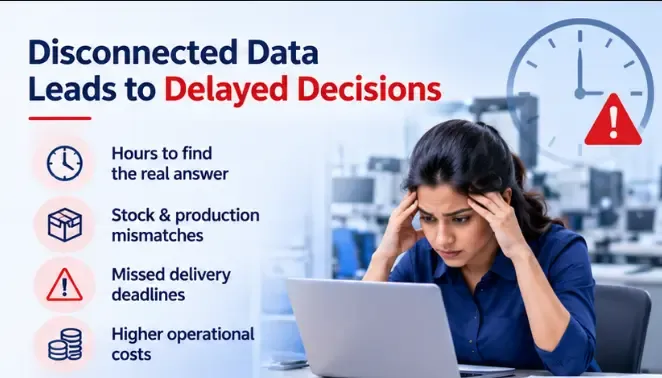
Managers waste hours copying numbers across spreadsheets
Senior operations heads burn 8 to 15 hours every week exporting CSVs, running fragile VLOOKUPs, and reconciling manual discrepancies just to prepare weekly review decks.
Every department argues over which version of the number is correct
Finance reports gross margin at 14%, Sales calculates 19%, and Operations claims 16%. Weekly leadership meetings devolve into data auditing debates instead of strategic problem-solving.
4. Why This Is a Bigger Issue in Chennai’s Industrial Corridors
This operational bottleneck is acute across Chennai’s heavy manufacturing belt, particularly within the state-run SIPCOT industrial parks across Sriperumbudur, Oragadam, Gummidipoondi, and Irungattukottai.
Automotive OEMs, tier-1 auto-component suppliers, consumer electronics manufacturers, and precision engineering plants in these industrial clusters operate fast-moving, tightly coupled production cells. In these environments, an unpredicted 15-minute line stoppage does not merely pause output—it creates ripple effects across global supply chains:
Violating Strict 2-Hour JIT Delivery Windows
Automotive OEM assembly plants operate on precise two-hour delivery slots. A delayed sub-assembly triggers punitive penalties and assembly standstill claims.
Compounding Shift Production Deficits
When stamping, molding, or surface-mount lines lose speed, downstream stations starve, forcing plants into unplanned weekend overtime shifts.
Port Cut-Off & Export Delays
Chennai and Ennore port container cut-off schedules tolerate zero schedule slippage; missing a vessel can delay international delivery by two to four weeks.
Traceability & OEE Penalties
Automotive and aerospace quality certifications require end-to-end component traceability linked to exact machine batch settings and operator IDs.
This is why manufacturers in SIPCOT industrial parks around Chennai need more than a monthly downtime report. They need production downtime tracking, OEE monitoring, and machine-level information that shows where losses happen and why they repeat.
5. Why More Reports & Spreadsheets Fail to Fix the Root Cause
When confronted with slow decision-making, most corporate IT departments and plant managers react by building more BI dashboards, mandating additional shift reports, or convening daily emergency alignment meetings. While well-intentioned, these measures fail because they treat the surface symptom rather than the underlying data pipeline.
More Dashboards Do Not Connect Systems
A BI visualization dashboard can only render what underlying software sends it. If ERP, shop-floor PLCs, CRM, and QA systems are not connected through bi-directional automated workflows, the dashboard merely displays incomplete, stale, and contradictory metrics with nicer graphs.
Spreadsheets Provide Speed, Not Governance
Spreadsheets are great for ad-hoc financial modeling. But when Excel becomes the permanent bridge between ERP and the factory floor, version conflicts, broken formulas, and manual copy-paste typos inevitably corrupt the integrity of operational numbers.
Point-to-Point Scripts Create Fragile Debt
Writing a quick custom script to push data from an inventory table to an invoicing tool may solve one isolated friction point today. However, as business requirements evolve, managing dozens of unmonitored scripts becomes a fragile maintenance nightmare that collapses during software upgrades.
IDC Supply Chain Transformation Research: IDC studies on digital transformation establish that restricted data accessibility, point-to-point integration debt, legacy system lock-in, and departmental data silos represent the leading reasons why enterprise digital initiatives stall and incur 40% higher maintenance costs.
6. How Business Process Automation Connects Your Data
The solution is never to indiscriminately buy more software packages. The solution is to build an automated operational bridge that connects processes, systems, and decisions.
Business Process Automation (BPA) combines workflow orchestration, API integrations, intelligent data validation, and AI logic to execute repetitive business steps without manual human handoffs. Instead of humans acting as human routers who copy-paste numbers between screens, the digital infrastructure moves and verifies data automatically:
Automated Order-to-Production Synchronization
Real-Time Order Ingestion
CRM captures customer order specs and synchronizes instantly with ERP ledger commitments.
Automated Stock & BOM Check
Automated reservation verifies raw material availability across warehouse bins in real time.
Machine Capacity Telemetry
Shop-floor IIoT controllers and PLC run-rates verify active line availability and tool condition.
Dynamic Decision & Alert Lock
Discrepancies escalate instantly; dispatch schedules lock dynamically while protecting gross margins.
This transformation converts business data from passive historical records into an active, event-driven engine that enables plant leadership to make rapid, confident operational decisions.
7. The 4-Step Framework: Connect, Clean, Automate, Decide
Before committing budget to expensive AI models or expansive IT overhauls, enterprise leaders should follow Vivify Soft Tech’s battle-tested 4-step framework: Connect, Clean, Automate, and Decide.
Most industrial plants already generate millions of data points every shift. The challenge is not creating more data—it is transforming fragmented data streams into automated pipelines that deliver actionable insights before micro-stops compound into major capacity losses.

Connect: Aggregate Data Streams Where Decisions Happen
Map the software, controllers, and paper logs currently housing critical operational facts. Connect ERP, MES, SCADA, CRM, and WMS without having to perform a high-risk multi-year rip-and-replace.
8. What Connected Operations Look Like in Practice
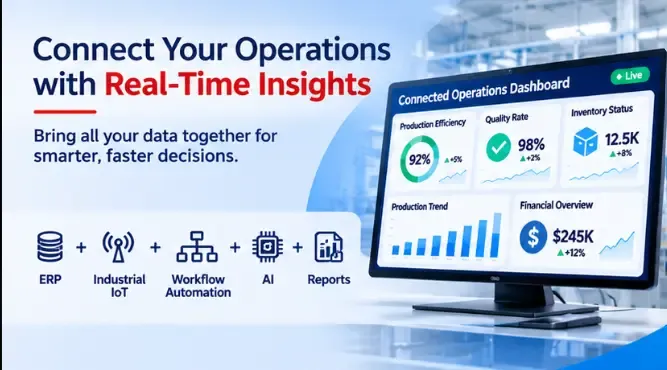
Connected operations do not require every employee to see every data point. Rather, they ensure that the right decision-maker receives verified, contextualized insights at the exact moment an action is required.
When machinery, ERP ledgers, and quality queues share an integrated data fabric, plant managers no longer wait for shift-end summaries. Telemetry anomalies instantly trigger maintenance work orders, stock levels dynamically update production runs, and customer dispatch commitments reflect live factory throughput.
| Before Connected Operations (Fragmented) | After Connected Operations (Automated) |
|---|---|
| Manual report generation across silos takes days; data is stale on arrival. | ERP, shop-floor, QA, and finance teams share a synchronized single pane of glass. |
| Decisions rely on outdated desktop spreadsheets and unverified departmental claims. | Executive and operational decisions are driven by automated, real-time verified data. |
| Quality defects are discovered after packaging or during customer incoming inspection. | Automated machine telemetry triggers instant quality alerts while parts are on the line. |
| Maintenance is reactive, rushing to unjam equipment after catastrophic failure. | Preventive work orders are triggered automatically based on runtime and condition data. |
| Weekly leadership reviews burn hours arguing over which department has the right numbers. | Leadership reviews focus entirely on strategic throughput, capacity expansion, and customer delivery. |
| AI projects fail because they run against fragmented, dirty, and incomplete datasets. | Enterprise AI tools deliver high predictive accuracy on top of unified, clean business data. |
9. Real-World Manufacturing Scenario: Resolving Bottlenecks
Automotive Component Manufacturer: Overcoming Stoppage Blindspots
6-Hour Information Delay
An automotive Tier-1 supplier experienced persistent delivery delays. Machine run data sat in Siemens PLCs, production schedules in SAP ERP, inspection results on QA sheets, and stock availability in warehouse spreadsheets.
When a high-speed stamping press stopped due to a feeder jam, the central planning team learned about the lost capacity only 6 hours later when the shift supervisor filed a paper report. By then, the shipment delivery commitment was irreparably compromised.
Closed-Loop Real-Time Resolution
By deploying Vivify Soft Tech’s connected automation framework, the press PLC was linked directly to the production monitoring engine and ERP.
The moment a 5-minute stoppage occurs, the system automatically adjusts the production run rate, dispatches a mobile notification to the maintenance lead, evaluates alternative machine line capacity, and updates the customer delivery risk index in real time.
10. Where Vivify Soft Tech Fits: End-to-End Integration
Once an enterprise recognizes where fragmented data is causing delays and capital loss, the critical challenge is execution. Vivify Soft Tech partners with manufacturing and commercial leaders across Chennai, Tamil Nadu, and India to implement resilient, scalable operational bridges:
ERP Integration & Hyperautomation
Bi-directional synchronization between ERP platforms (SAP, Oracle, Dynamics, custom systems) and third-party applications, automating data verification and order lifecycle flows.
Explore Hyperautomation ServicesIndustrial IoT & FactorAI Platform
Connect shop-floor PLCs, sensors, and SCADA infrastructure into our proprietary FactorAI dashboard for real-time OEE analysis, downtime classification, and predictive maintenance.
Explore Industrial Software SolutionsAI-Powered Decision Intelligence
Deploy pragmatic, custom AI algorithms that detect subtle throughput anomalies, forecast stock replenishment windows, and flag margin compression risks before month-end.
Explore AI-Powered Solutions11. 7-Point Pre-Implementation Checklist
Before launching a business process automation or system integration project, answer these fundamental diagnostic questions with your leadership team:
High-Delay Decisions
Decision VelocityWhich 5 operational decisions consistently suffer from the longest delays, rework cycles, or financial losses?
Source System Mapping
Data ArchitectureWhich specific applications, machine controllers, or spreadsheets currently house the required facts?
Manual Copy-Paste Audit
Workforce FrictionWhere are employees manually typing, cross-referencing, or emailing numbers between separate screens?
Entity Discrepancy Spotting
Master DataWhich master data fields (e.g., item codes, machine numbers, customer IDs) have conflicting formats across teams?
Process Ownership & Fast ROI
Pilot SelectionWhich single process has a clear departmental owner, an established baseline metric, and the fastest potential payback?
Human Judgment Boundaries
GovernanceWhich edge-case situations and commercial thresholds still require human executive review and authorization?
Metric of Success Definition
ROI VerificationHow will you measure project ROI: decision velocity, inventory accuracy, unlogged micro-stop reduction, or on-time delivery?
Implementation Advice: Never attempt a high-risk plant-wide overhaul on day one. Connect one machine line or business workflow, automate the handoffs, prove measurable ROI within 30 to 60 days, and scale systematically.
12. Frequently Asked Questions (FAQs)
Business process automation uses software, integrations, workflows, and AI to complete repetitive business tasks with minimal manual intervention. It moves data between systems, validates information, triggers approvals, sends alerts, and updates operational records automatically in real time.
13. Industry Citations & Internal Resources
Internal Guides & Solutions
- ERP Integration & Business Process Automation Services
- Industrial IoT Solutions Chennai & Smart Factory Systems
- AI-Powered Business Process Automation
- FactorAI: AI-Powered Manufacturing Platform
- Case Study: ERP Transformation for Precision Manufacturing
- Case Study: Connected Factory Automation in Tamil Nadu
Authoritative Industry Research
Stop Managing Disconnected Systems.
Start Building Connected Operations.
Discover how Vivify Soft Tech combines AI, ERP integration, and intelligent workflow automation to give your manufacturing or commercial enterprise real-time decision clarity.